



How a comprehensive Google Ads audit, keyword restructuring, conversion tracking cleanup, landing-page corrections, and hyper-local campaign expansion increased the qualified lead rate from 12.2% to 47.7%.
The Challenge
When I took over the Google Ads account for this client on June 19, 2026, the account was generating leads, but a significant percentage of those leads were not qualified.
The problem wasn’t simply a lack of traffic. The account needed better control over who was seeing the ads, what searches triggered them, where users were being sent, and which actions Google Ads was treating as conversions.
The initial audit revealed broad or poorly aligned keywords, geographic mismatches, competitor-related searches, irrelevant service searches, problematic landing-page URLs, and conversion actions that were giving Google Ads misleading optimization signals.
The goal was therefore not to generate as many leads as possible. The goal was to generate more qualified opportunities from the advertising budget.
The Results
The improvement became increasingly visible as the account was restructured.
| Period | Total Leads | Qualified Leads | Qualification Rate | Ad Spend | Cost / Lead | Cost / Qualified Lead |
|---|---|---|---|---|---|---|
| June 19–30 | 49 | 6 | 12.2% | $6,551 | $134 | $1,092 |
| July | 67 | 17 | 25.4% | $19,045 | $284 | $1,120 |
| August | 65 | 31 | 47.7% | $20,182 | $310 | $651 |
The most important change was lead quality. From the initial June 19–30 period to August:
- Qualified leads increased from 6 to 31
- Qualification rate increased from 12.2% to 47.7%
- Qualified lead volume increased more than fivefold
- Cost per qualified lead decreased from $1,092 to $651
The account therefore wasn’t simply producing more activity. A substantially larger percentage of the lead pipeline was becoming qualified.
Account-Level Results
| Metric | Before | After | Change |
|---|---|---|---|
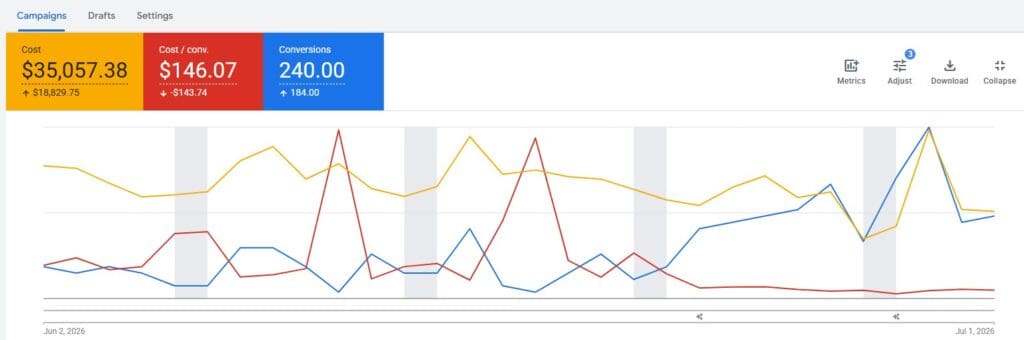
| Total Conversions | 112 | 184 | +64% |
| Cost Per Conversion | $176.44 | $81.34 | −54% |
| Phone Calls | 26 | 73 | +181% |
| Total Ad Spend | $19,761 | $14,966 | −24% |
These figures represent the account-level comparison and are separate from the 13-day campaign-level comparison shown elsewhere in this case study.
What Was Wrong With the Google Ads Account?
The first step was to understand why the account was producing so much unqualified traffic.
A full keyword audit across the active Search campaigns found keywords that were:
- Too broad
- Geographically irrelevant
- Outside the company’s actual service offering
- Related to informational rather than buying intent
- Related to competitors
- Competing for budget unnecessarily
This meant Google Ads had too many opportunities to spend money on searches that were unlikely to become legitimate window, door, siding, or remodeling opportunities.
Removing Low-Quality Keywords
In the Windows Search campaign alone, I paused 34 exact-match keywords that were generating irrelevant traffic.
I also paused seven phrase-match financing keywords because financing was not a core offer at that point, while re-enabling ten high-priority keywords that had previously been paused incorrectly, including terms related to:
- Window replacement
- Window installers
- Home window replacement
- Local window searches
Similar cleanup was performed across the Bathroom, Siding, and Brand campaigns.
The objective was to shift the account away from simply matching searches and toward matching commercial intent that aligned with the actual services being sold.
Tightening Geographic Targeting
For a local window company, geographic relevance is critical.
The account contained searches that were outside the company’s service area, so I added geographic negative keywords to prevent advertising dollars from being spent on locations the company did not serve.
I also tightened the Entry Doors Performance Max campaign so that targeting focused on people physically located in the target service area, rather than people who were merely searching for or showing interest in the area.
This is an important distinction for local lead generation: someone researching a company from outside the market is not necessarily a potential customer.
Rebuilding the Campaign Structure
After the initial keyword cleanup, the campaigns needed to be reorganized around the services and traffic sources that were most likely to produce quality leads.
Windows and Doors ultimately became the primary focus because they were producing the highest-quality leads. On July 17, the Siding Search and Bathroom Search campaigns were paused so budget could be consolidated into the stronger-performing areas.
This wasn’t a decision to permanently eliminate services.
It was a budget-allocation decision based on the quality of the leads being generated.
Fixing Conversion Tracking
One of the most important parts of the project wasn’t a keyword change at all.
It was fixing the conversion data.
The account had multiple conversion actions that could inflate reported conversions without necessarily representing a legitimate lead. These included:
- Local action menu views
- Website visits
- Chat leads
- YouTube engagement
- Call from Ads
- Multiple lead-form actions
I rebuilt the custom conversion goal to focus on meaningful lead signals, including calls and the lead form. I also removed or demoted conversion actions that were not appropriate primary optimization signals and eliminated actions that could result in double counting.
Why Conversion Tracking Matters
Google Ads automation is only as useful as the conversion data it receives.
If Google is told that low-intent actions are conversions, its bidding algorithms can learn to find more users who perform those actions.
That can create an account that appears successful inside the Google Ads interface while producing disappointing business results.
By cleaning up the conversion architecture, the account could begin optimizing toward actions that more closely represented actual lead intent. The report identifies conversion tracking cleanup as one of the key drivers of improvement.
Correcting Landing Page Problems
The audit also uncovered an important technical problem with the ads.
Some Brand campaign advertisements were directing visitors to a staging subdomain rather than the live website.
That meant users could click an ad and potentially be sent somewhere other than the intended customer-facing page.
I corrected the Brand campaign URLs, updated the Entry Doors Performance Max landing page, and created a dedicated Siding landing page with the corresponding RSA updated to use it.
Later, additional sitelink URLs were consolidated and broken or staging URLs were removed.
I also opted the Windows Search campaign out of Final URL expansion so Google could not automatically redirect traffic to pages that had not been reviewed.
Building a Hyper Local Windows Campaign
Once the account was cleaned up, the next opportunity was to expand qualified local coverage.
On August 14, a new Windows Search campaign was built from scratch using an exact-match strategy focused on hyper-local window replacement searches throughout the company’s service area.
The campaign included more than 100 geographically targeted exact-match keywords covering multiple communities within the target market, along with city-specific window replacement and installer searches.
The campaign also included high-intent searches related to:
- Window replacement
- Window installation
- Window installation services
Two responsive search ads were created with messaging around window financing and the company’s buy-back offer, with traffic directed to the appropriate window financing landing page.
This gave the account much more granular control over the relationship between location + service + search intent.
Competitor Negative Keyword Strategy
Another major source of wasted spend was competitor research.
Rather than allowing the campaigns to continually pay for searches from people specifically researching competing companies, I developed comprehensive competitor negative keyword lists.
The account-level strategy eventually included 57 competitor brand phrase-match negatives, while additional campaign-specific competitor negatives were added to the Windows, Bathroom, Brand, and Entry Doors campaigns.
A separate 31-keyword competitor negative list was also built and applied across the active campaigns.
Informational searches were also addressed by adding negatives for terms such as:
- How to
- What is
- Review
The purpose was straightforward: reduce the amount of advertising budget spent on people who were researching rather than looking to hire a contractor.
Bid Strategy Was Adjusted as the Account Stabilized
The bidding strategy was not left untouched throughout the restructuring.
Immediately after the keyword restructuring, Windows Search and Bathroom Search were temporarily moved from Maximize Conversions to Maximize Clicks to rebuild traffic volume and allow the campaigns to accumulate useful data.
As the Windows campaign accumulated enough conversion data, it was moved back to Maximize Conversions.
The Entry Doors Performance Max campaign was also relaunched with Maximize Conversions and the appropriate custom conversion goal.
This staged approach allowed the account structure and conversion data to be cleaned up before relying more heavily on automated bidding.
What Actually Changed?
The turnaround wasn’t the result of one optimization. It came from addressing the account at multiple levels:
1. Keyword targeting
Low-quality, irrelevant, geographically inappropriate, and poorly aligned keywords were removed.
2. Campaign structure
Budget was consolidated around Windows and Doors, where the account was producing stronger-quality leads.
3. Conversion tracking
Low-value and duplicate conversion actions were removed so Google Ads could optimize toward meaningful lead signals.
4. Landing pages
Staging URLs, incorrect destinations, and poorly controlled final URLs were corrected.
5. Geographic targeting
Location targeting and geographic negative keywords were tightened.
6. Competitor protection
Competitor searches were systematically excluded to reduce wasted spend.
7. Local keyword expansion
A new exact-match campaign created highly targeted coverage throughout the company’s service area.
8. Bid strategy
Bidding strategies were adjusted as the account moved from restructuring into a more stable conversion-data environment.
The report identifies this combination of keyword restructuring, landing-page corrections, conversion tracking cleanup, and the new exact-match Windows campaign as the primary drivers of the improvement.
The Outcome: Better Leads, Not Just More Leads
The most meaningful result from this project was the change in lead quality.
During the initial June 19–30 period, the account generated 49 leads, but only six were qualified a 12.2% qualification rate.
By July, qualified leads had increased to 17 and the qualification rate had more than doubled to 25.4%.
In August, the account generated 65 total leads and 31 qualified leads, producing a 47.7% qualification rate.
At the same time, the cost per qualified lead dropped to $651, compared with $1,092 during the initial June period.
That distinction matters.
The objective of a local contractor’s Google Ads campaign isn’t to produce the largest possible number of form submissions or phone calls.
It’s to produce opportunities that have a realistic chance of becoming customers.
The Financial Impact
The account spent $6,551 during the initial June 19–30 period, $19,045 in July, and $20,182 in August.
While the overall cost per lead increased as the account was restructured from $134 initially to $310 in August, the more important metric was the cost of acquiring a qualified lead.
That figure improved substantially:
$1,092 → $1,120 → $651
By August, the account was generating qualified leads at roughly 40% lower cost than during the initial takeover period, while the qualified lead rate had increased from 12.2% to 47.7%.
This is an important example of why looking only at cost per lead can be misleading.
A $100 lead isn’t necessarily better than a $200 lead if the $200 lead is dramatically more likely to become a real customer.
For this account, the focus shifted from cheap leads to qualified leads.
Key Takeaways for Window Companies Running Google Ads
This account illustrates several problems I commonly look for when auditing Google Ads campaigns for home-service businesses.
More keywords don’t necessarily mean more customers. Poorly targeted keywords can increase traffic while decreasing lead quality.
Conversion tracking needs to reflect the actual business objective. If Google is optimizing toward weak or duplicated conversion signals, automation can work against the business.
Local targeting needs to be specific. For contractors, geographic relevance can have a major impact on lead quality.
Landing pages matter. Sending paid traffic to incorrect, staging, broken, or poorly matched destinations creates unnecessary friction.
Competitor searches can consume budget quickly. A deliberate negative-keyword strategy can help prevent campaigns from paying for low-value competitor research.
Lead quality should be measured separately from lead volume. In this account, the qualification rate was a much more meaningful indicator of improvement than total lead count alone.
About the Google Ads Management
This account was taken over on June 19, 2026, with Christopher Berry as the primary account manager in July.
The work documented in this case study covers the period from June 19 through September 3, 2026 and includes the account audit, keyword restructuring, campaign changes, landing-page corrections, conversion tracking cleanup, negative keyword development, local campaign expansion, and bid strategy adjustments.
The work was focused on one central objective:
Make Google Ads produce better opportunities for the business, not simply more activity inside the advertising account.
Need Help Improving Your Google Ads Lead Quality?
If your home-service Google Ads account is generating clicks and conversions but too many of those leads aren’t turning into real opportunities, the problem may be deeper than your ad copy.
I can audit the account, identify wasted spend and weak targeting, clean up conversion tracking, restructure campaigns, and build a strategy focused on generating higher-quality leads.
Frequently Asked Questions
Ready to See What Your PPC Account Can Do?
Want to see how I approach paid advertising for window and siding contractors? Visit my Window and Siding Marketing page or my Google Ads PPC Consultant page to learn more about how I build high-converting campaigns for home improvement businesses.
Let’s Talk
If your Google Ads are spending but not producing enough booked jobs, there’s usually a structural problem in the account that an audit will uncover. After the audit and rebuild you’ll see where budget was being wasted and how much more you can get from better targeting and cleaner campaign setup. If you want more high value calls lower cost per lead and a setup that can actually scale in your market let’s talk about a strategy built for your service area and your goals. You can start with a straightforward account review and no obligation conversation about what your campaigns could be doing for your business.
You agree to receive email communication from us by submitting this form.